Free Drop No. 7 · November 2026
The Receipt Problem
The one piece of paper almost everyone touches every day, what is coated on it, and the easy habits that keep it off your hands and out of your lunch.
Nobody thinks twice about the receipt. It shows up at the end of every errand, gets folded into a pocket, handed to a kid, and forgotten. Here is what is actually on it, what the research found, and why the fix costs nothing.
Most receipts are printed with heat, not ink
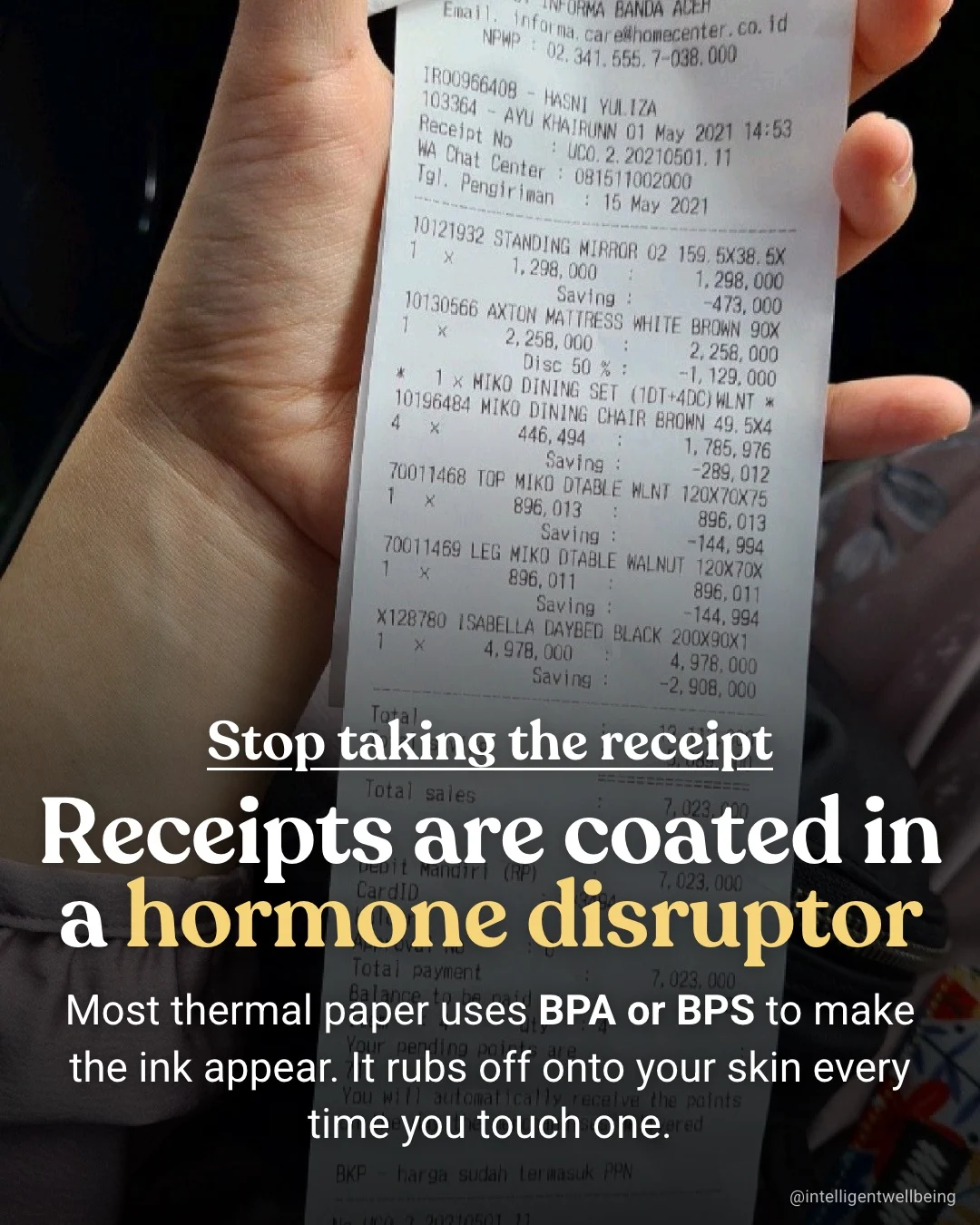
Run a fingernail across a fresh receipt and it leaves a dark line. That is because most receipts are thermal paper. There is no ink cartridge in the register. The paper itself is coated with a developer chemical that darkens when the print head heats it.
For years the most common developer was bisphenol A, better known as BPA, the same compound people learned to avoid in water bottles and can linings. On receipts it is not sealed inside anything. It sits loose on the surface, which is why it transfers so easily to whatever touches it.
One research team measured roughly 20 milligrams of BPA per gram of paper on the receipts they tested. Compared with the trace amounts that migrate out of a can, that is a lot of BPA sitting on the outside of something we hold with our bare hands.
There is no ink cartridge in the register. The paper itself is the chemistry.
Two hours of handling receipts, and three times the BPA
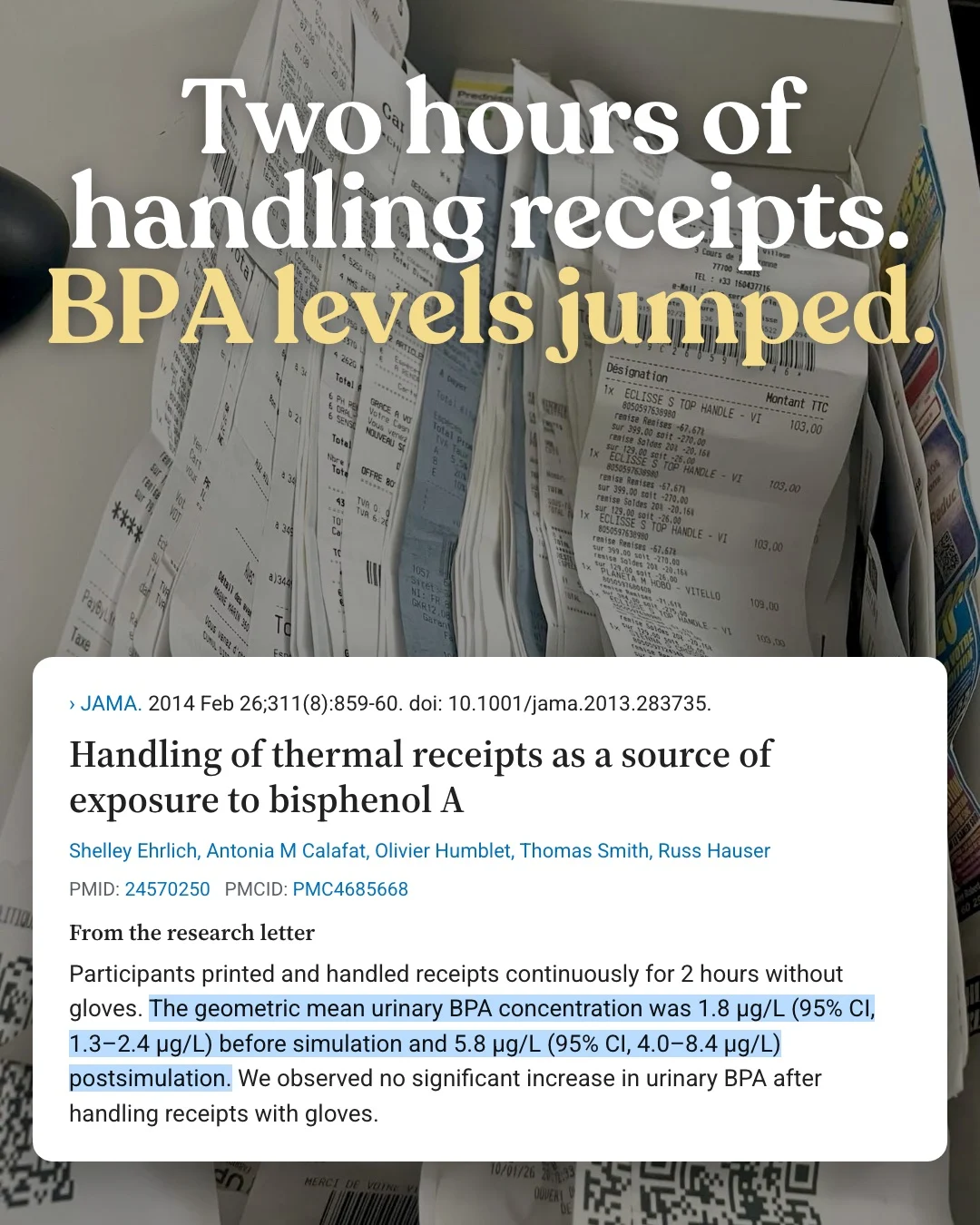
In 2014, researchers at Harvard and the CDC asked 24 volunteers to do something mundane: print and handle receipts for two hours, the way a cashier might. They measured the BPA in their urine before and after.
Without gloves, average urinary BPA went from 1.8 to 5.8 micrograms per liter. In a smaller group they followed over a full day, levels kept climbing for hours and peaked around eight hours after handling. When the same people wore nitrile gloves, there was no meaningful rise at all.
The authors were careful to note that the bump was smaller than what they had seen after people ate canned soup. That is a fair point, and also not very comforting. Receipts are one more small, daily source, and it is one of the easiest to cut.
Average urinary BPA before two hours of bare-handed receipt handling.
Average after handling. Levels kept rising for several hours in the follow-up group.
Nitrile gloves blocked the increase completely.
Hand sanitizer, then a receipt, then French fries
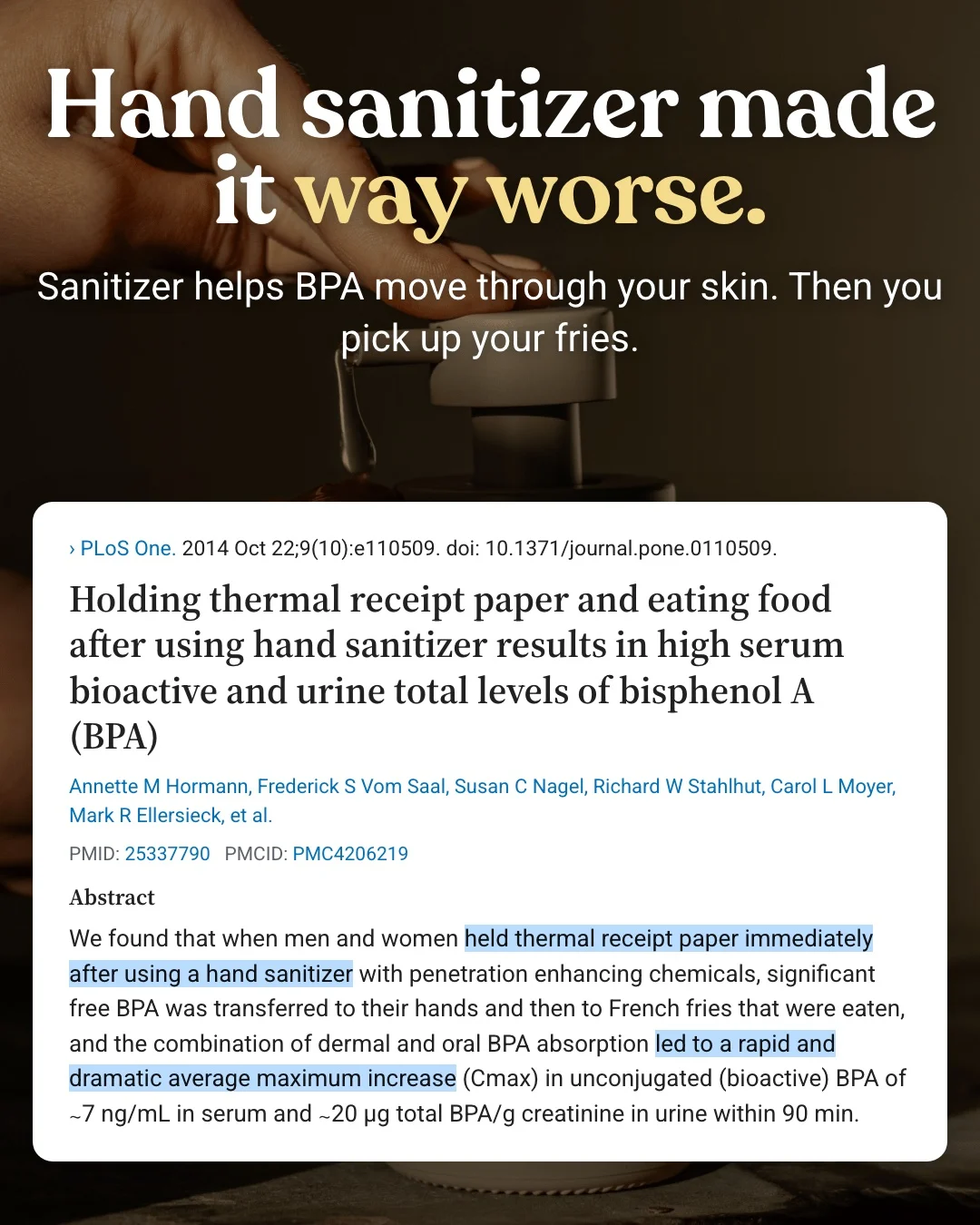
A second study the same year looked at the most ordinary sequence imaginable: clean your hands with sanitizer, take the receipt, eat a few fries.
Sanitizers contain ingredients designed to help things pass through skin. When volunteers held receipt paper right after using one, BPA moved onto their hands quickly, then onto the fries, and their blood levels of active BPA rose within about 90 minutes. Holding the same paper with dry hands transferred far less.
That is the whole reason the slide says wash, don’t sanitize. Soap and water after an errand takes the residue off. Sanitizer, followed by a snack, does the opposite.
Cashiers, and the swap that wasn’t much of a fix
If anyone was going to show it, it would be the people handling receipts all shift. A 2016 study of 77 cashiers found that those working with BPA receipts had higher urinary BPA after work than people in other jobs. Cashiers using paper made with BPS, a close chemical cousin, saw their BPS levels climb over the course of a shift.
That second part matters. As BPA got a bad reputation, a lot of paper quietly switched to BPS and similar compounds. Lab research suggests BPS is hormonally active too. Paper labeled “BPA-free” is not automatically paper you want on your hands all day.
Europe took a firmer line. Since January 2020, thermal paper sold in the EU can’t contain more than 0.02% BPA by weight. The US has no federal equivalent.
“BPA-free” can simply mean it was swapped for a cousin.
Five habits, all free
None of this requires a new product. It is a handful of small defaults that add up.
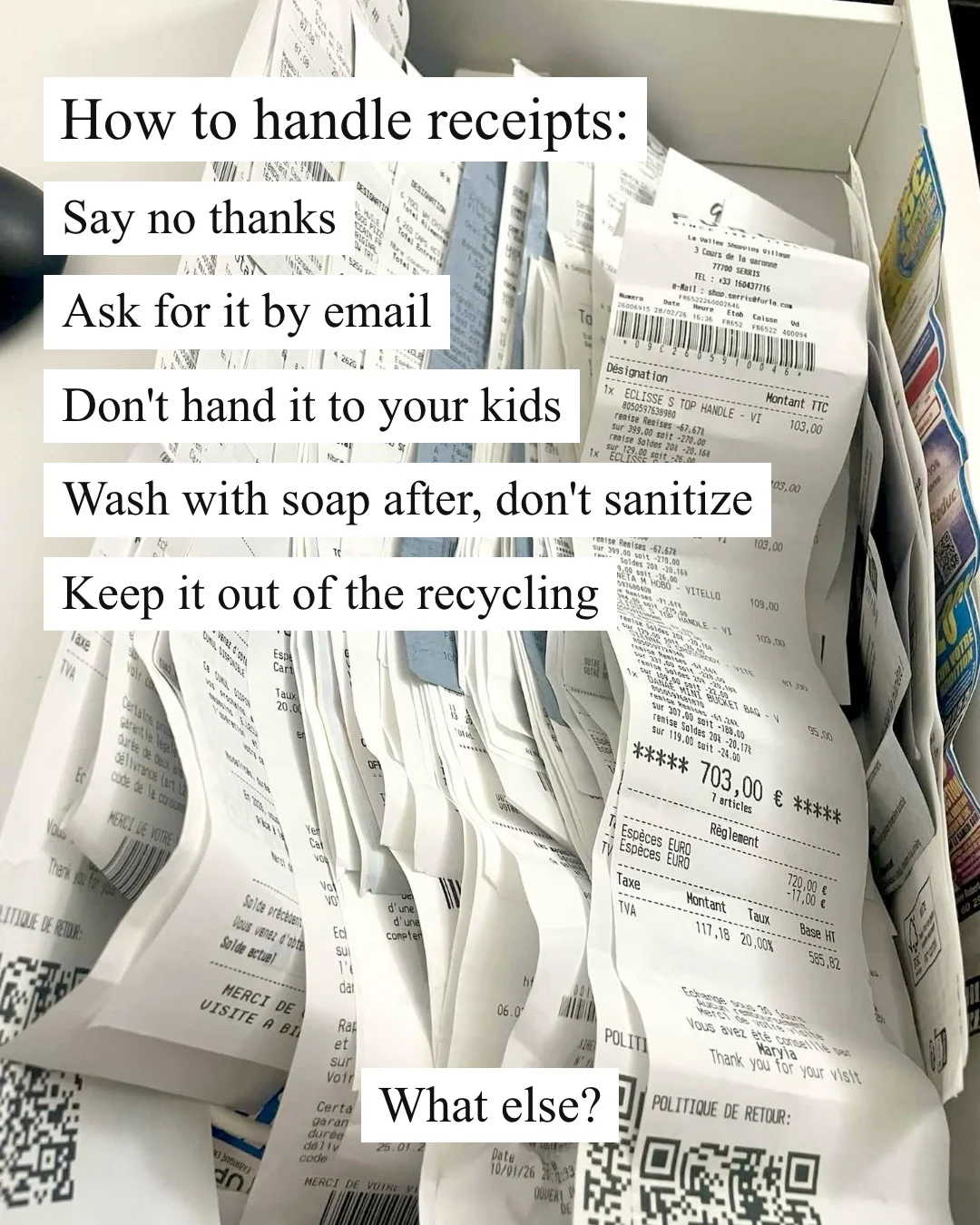
- 1Say no thanks
Most stores do not need to hand you a receipt. If you do not need it for a return, skip it.
- 2Ask for it by email
Digital receipts carry no coating. Most big chains offer them at the register or in their app.
- 3Keep receipts away from kids
Little hands go straight to mouths. Hand them a crayon instead.
- 4Wash with soap after errands
Plain soap and water, especially before eating. Skip the sanitizer right before you touch paper or food.
- 5Keep thermal paper out of the recycling
Coated receipts can carry bisphenols into recycled paper products. They belong in the trash.