Free Drop No. 9 · November 2026
Take Note of Japan
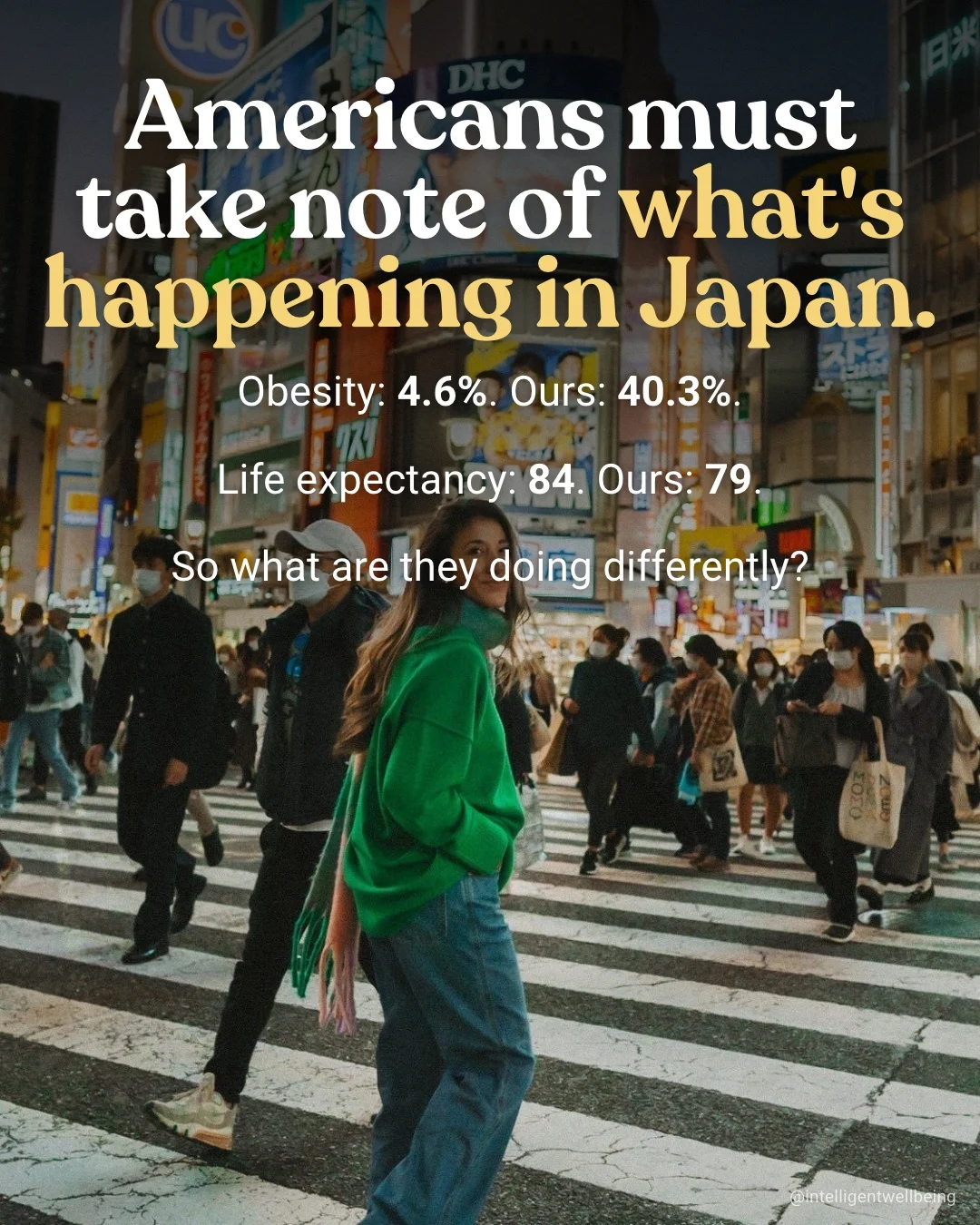
One of the lowest obesity rates in the developed world, some of the longest lives, and almost none of it comes from a supplement aisle.
Japan isn’t doing anything complicated. They walk, they eat smaller portions of real food, they teach kids how to eat at school, and they take a hot bath before bed. Basics, done every day, for generations.
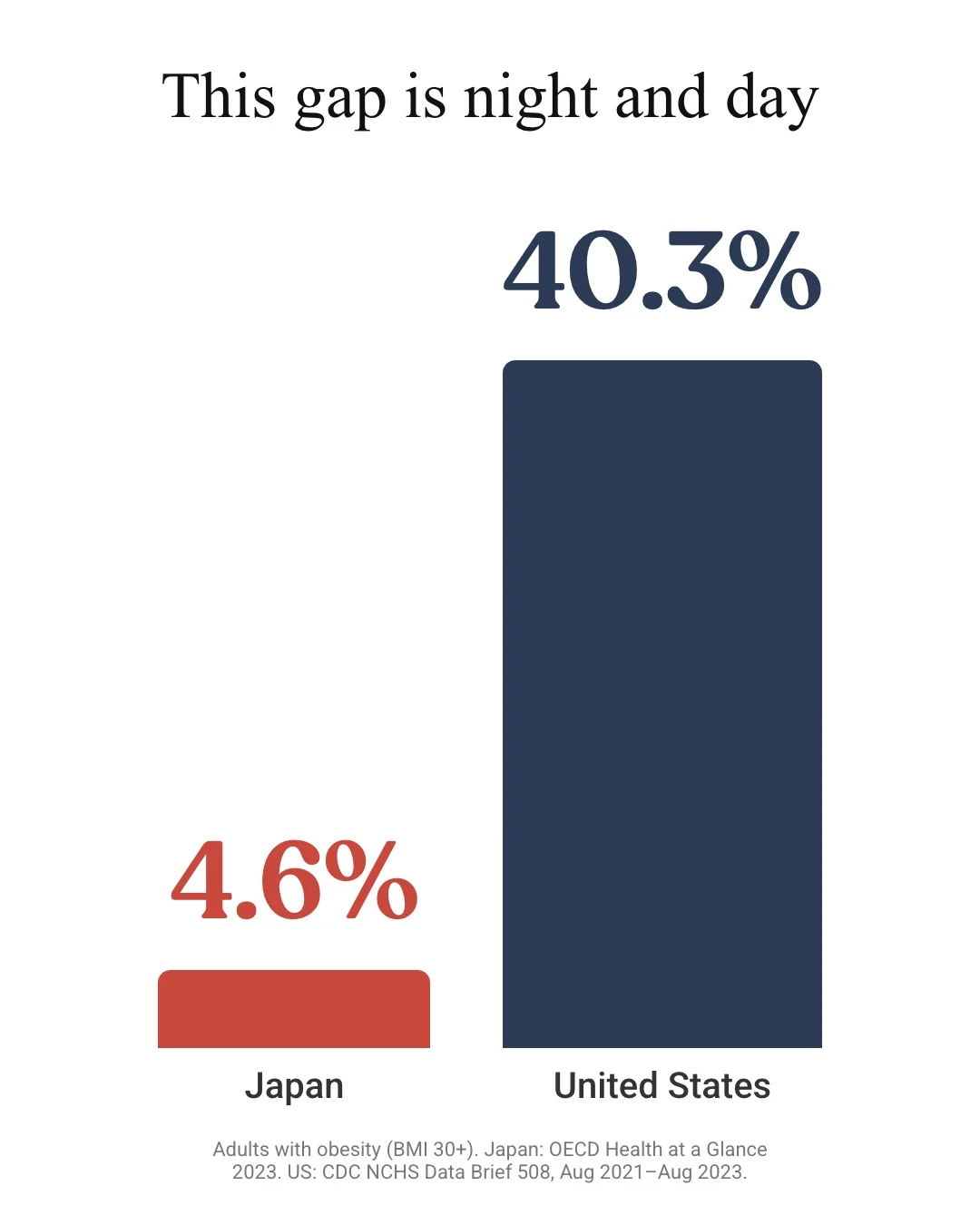
This gap is night and day
About 4.6% of adults in Japan have obesity, measured as a BMI of 30 or more. In the United States, it is 40.3%. That is not a rounding error. It is a different way of living.
Life expectancy tells a similar story: about 84 years in Japan, about 79 here. Genetics plays a part, and Japan has its own problems, from long work hours to an aging population. But the daily habits are a big part of it, and most of them are free.
They walk. Everywhere
When Stanford researchers analyzed step data from about 717,000 smartphone users in 111 countries, users in Japan averaged about 6,000 steps a day. Users in the US averaged about 4,800.
The difference is not willpower. It is design. Trains instead of cars, stairs at every station, the walk to the corner shop. Movement is built into ordinary days, so nobody has to schedule it.
Average daily steps among smartphone users in the Stanford dataset.
About 1,200 fewer steps a day, every day.
Roughly how many more steps that adds up to over twelve months.
School lunch is a class, not a cafeteria
Nearly every public elementary and middle school in Japan serves school lunch, and it is treated as part of the school day. Kids put on little white coats, serve their classmates, eat in the classroom with their teacher, and clean up after.
In 2005 Japan passed the Basic Act on Shokuiku, which roughly means food and nutrition education. Schools have nutrition teachers. Kids learn where food comes from, how it is cooked, and how to eat with other people. They grow up treating a meal as something you sit down for.

They stop eating at 80% full
In Okinawa, older generations have a phrase for it: hara hachi bu, eat until you are 80% full. Smaller bowls, more dishes, slower meals.
A typical home meal is fish, rice, miso soup, pickles, vegetables, and green tea. Nothing about it is diet food. It is simply portioned like it was made for one person, eaten sitting down, and finished before anyone feels heavy.
Nothing about it is diet food. It is just portioned for one person and eaten sitting down.
Six Japanese habits that travel well
You don’t need to move to Tokyo. Most of this works in a Midwest suburb.
- 1Walk one errand a day
Pick the closest one and leave the car. Stairs over elevators, every time.
- 2Use smaller bowls
Same food, smaller dishes. Your eyes stop asking for seconds.
- 3Eat sitting down, without a screen
Meals are an event, even a ten-minute one.
- 4Stop at 80%
Pause before the last few bites. Most of the time you are done.
- 5Make fish, rice, and vegetables a weeknight default
Simple, cheap, fast, and hard to overeat.
- 6End the day with a hot bath
The Japanese evening bath is a wind-down ritual as much as a wash.