Free Drop No. 6 · Summer 2026
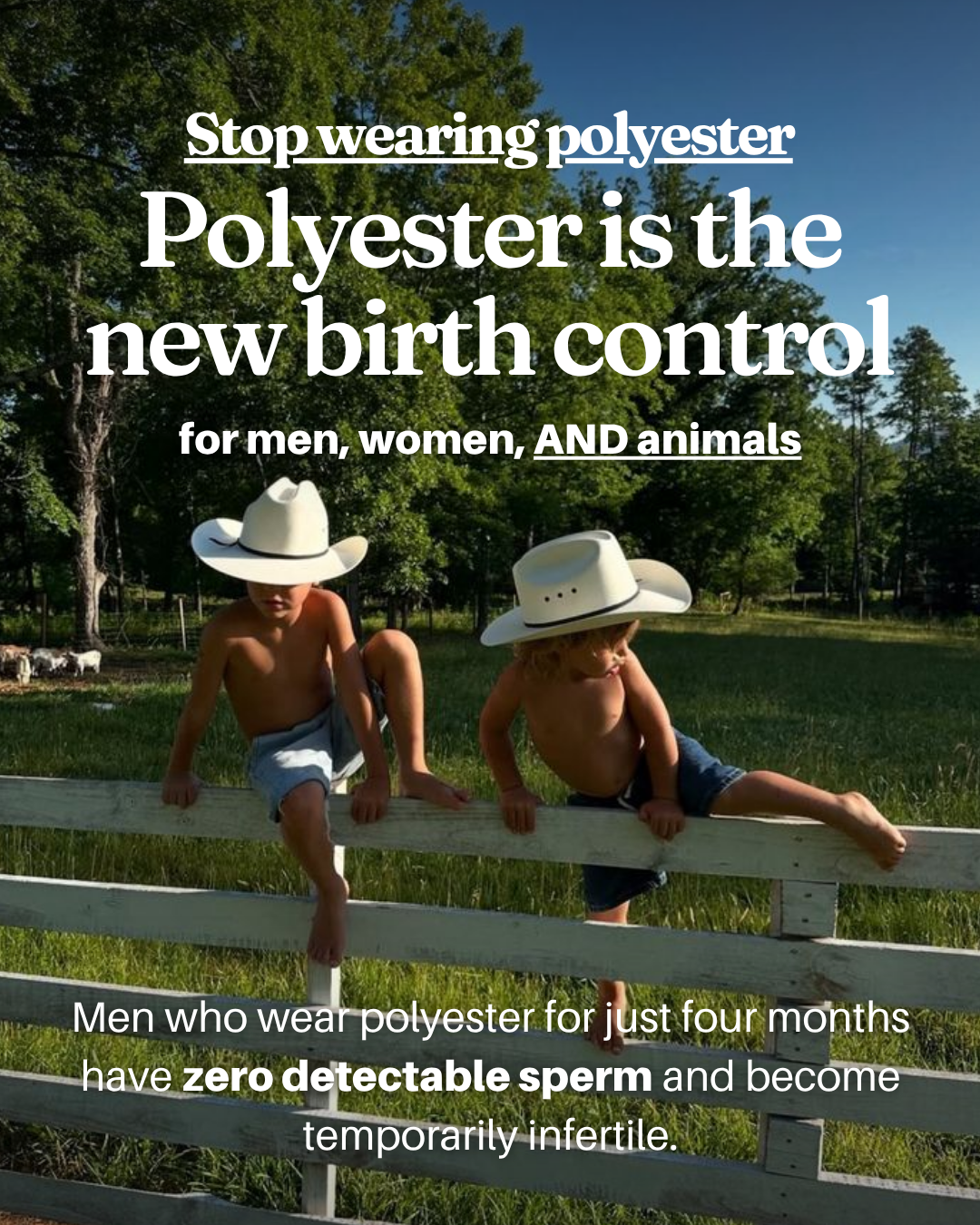
Polyester Is the New Birth Control
A field guide to the plastic in your closet: what it may be doing to your fertility, why your clothes are shedding microplastics into you, and how cotton, wool, and linen quietly fix most of it.
Here is a sentence we did not expect to write in a wellness magazine: your gym shorts may be moonlighting as contraception. The science behind it is real, slightly ridiculous, and genuinely worth knowing. Pour a coffee.
Polyester is, technically, birth control
It sounds like a line invented purely to travel across the internet, and to be fair, it travels beautifully. But the headline has a real paper trail behind it, and the paper trail is stranger than the meme. Researchers have spent decades showing that wrapping reproductive anatomy in plastic fabric does measurable things to fertility. In men. In dogs. Reliably enough that someone proposed it, with a straight face, as a method of contraception.
Before anyone panics and sets fire to their wardrobe: the dramatic results came from a very specific, very committed use of polyester that nobody is recreating by accident. We will get to that fine print, because the fine print is the genuinely useful part.
The bigger story is the one sitting underneath the punchline. Polyester is plastic. You are wearing plastic, most of the day, pressed against the largest organ you own. Once you start seeing clothing that way, the appeal of cotton, wool, and linen stops being a matter of taste and starts looking like basic hygiene.
We have one stubborn belief here that keeps turning out to be true. The non-toxic version and the beautiful version are almost always the same version. Fabric, it turns out, is no exception.
Polyester is plastic. You are wearing plastic, most of the day, against the largest organ you own.
Fourteen volunteers, one polyester sling, zero sperm
In 1992, a researcher named Ahmed Shafik published a study in the journal Contraception with a premise that would struggle to clear a modern ethics board on charm alone. Fourteen healthy men agreed to wear a polyester sling, day and night, for a full year, swapping it only when it got dirty. Their partners stayed on the pill until the men’s samples proved the point.
The point proved itself in about four and a half months. Every man became azoospermic, meaning no detectable sperm, somewhere between 120 and 160 days after starting. They stayed that way for the rest of the year. Not one partner became pregnant during the study.
Then they took the slings off, and everything came back. Counts returned to normal within a few months. Five couples who wanted to conceive afterward did. The effect was real, complete, and fully reversible, which is exactly what you want from contraception and exactly what you do not want from a t-shirt you forgot you owned.
Healthy male volunteers, wearing a polyester sling around the clock for twelve months.
Average time to reach azoospermia. Every man got there. None conceived during the study.
Counts returned to baseline after removal. Couples who wanted to conceive afterward did.
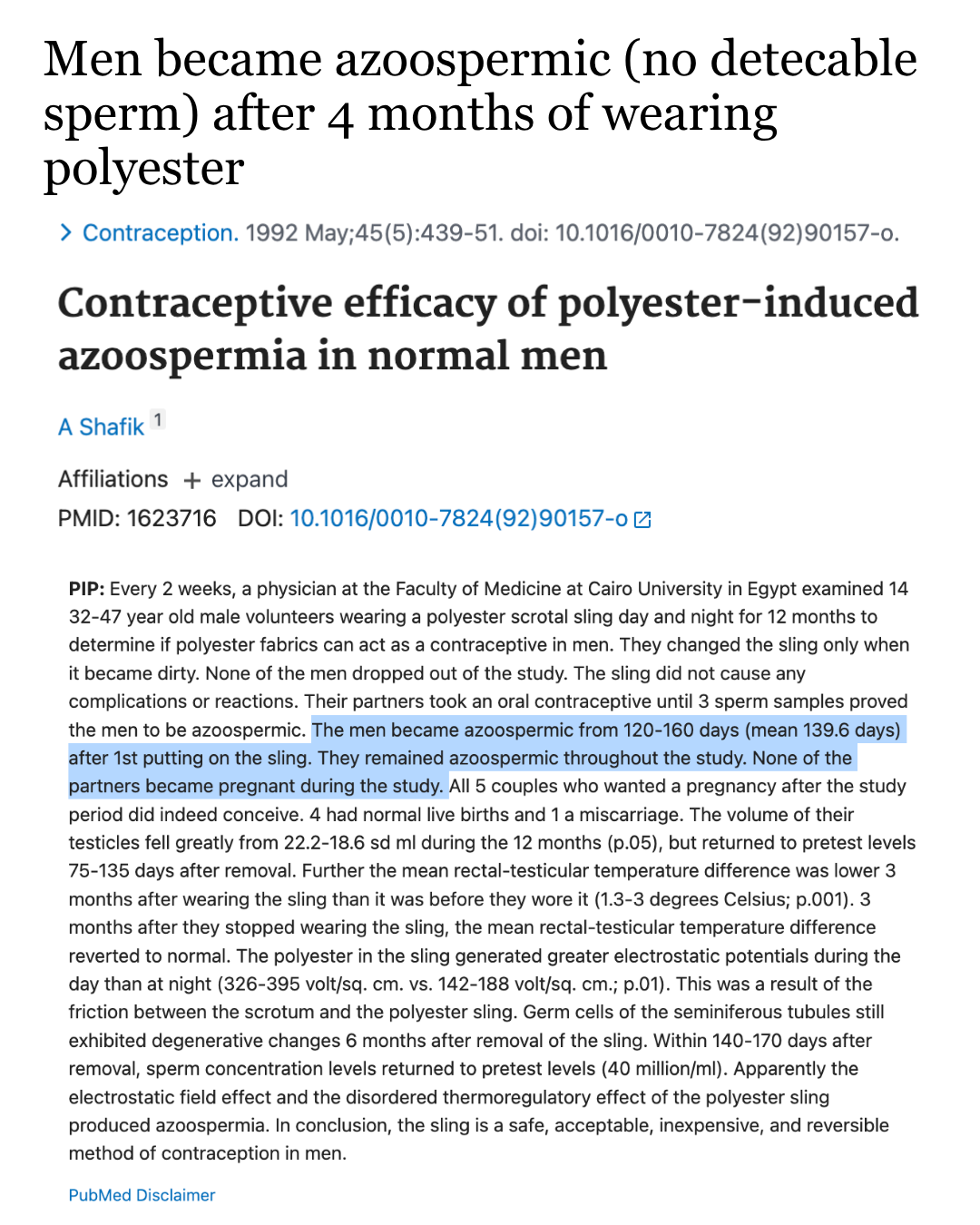
This was a snug scrotal sling worn twenty-four hours a day, not a pair of polyester joggers. The effect ran on heat and static, which we will get to in a minute, and it came from one prolific researcher rather than a crowd of independent labs. Treat it as a vivid proof of concept, not a warning that your boxer shorts will sterilize you by Friday.
They put pants on dogs. For science.
The same researcher, evidently not finished, turned to female fertility and answered the question in the most 2008 way imaginable: by dressing dogs in tiny custom underpants. Thirty-five female dogs, five groups, four fabrics, polyester, a polyester-cotton blend, pure cotton, and pure wool, worn for a year.
The dogs in anything containing polyester had a problem. Their progesterone dropped during the part of the cycle where it is supposed to climb, and they did not conceive, by mating or by insemination. The dogs in plain wool and cotton were entirely unbothered and got pregnant on schedule.
Five months after the pants came off, the polyester group’s hormones normalized and they conceived too. Same pattern as the men. Same reversibility. The proposed culprit was a faint electrostatic field generated by the plastic against skin, quietly interfering with the hormonal machinery underneath.
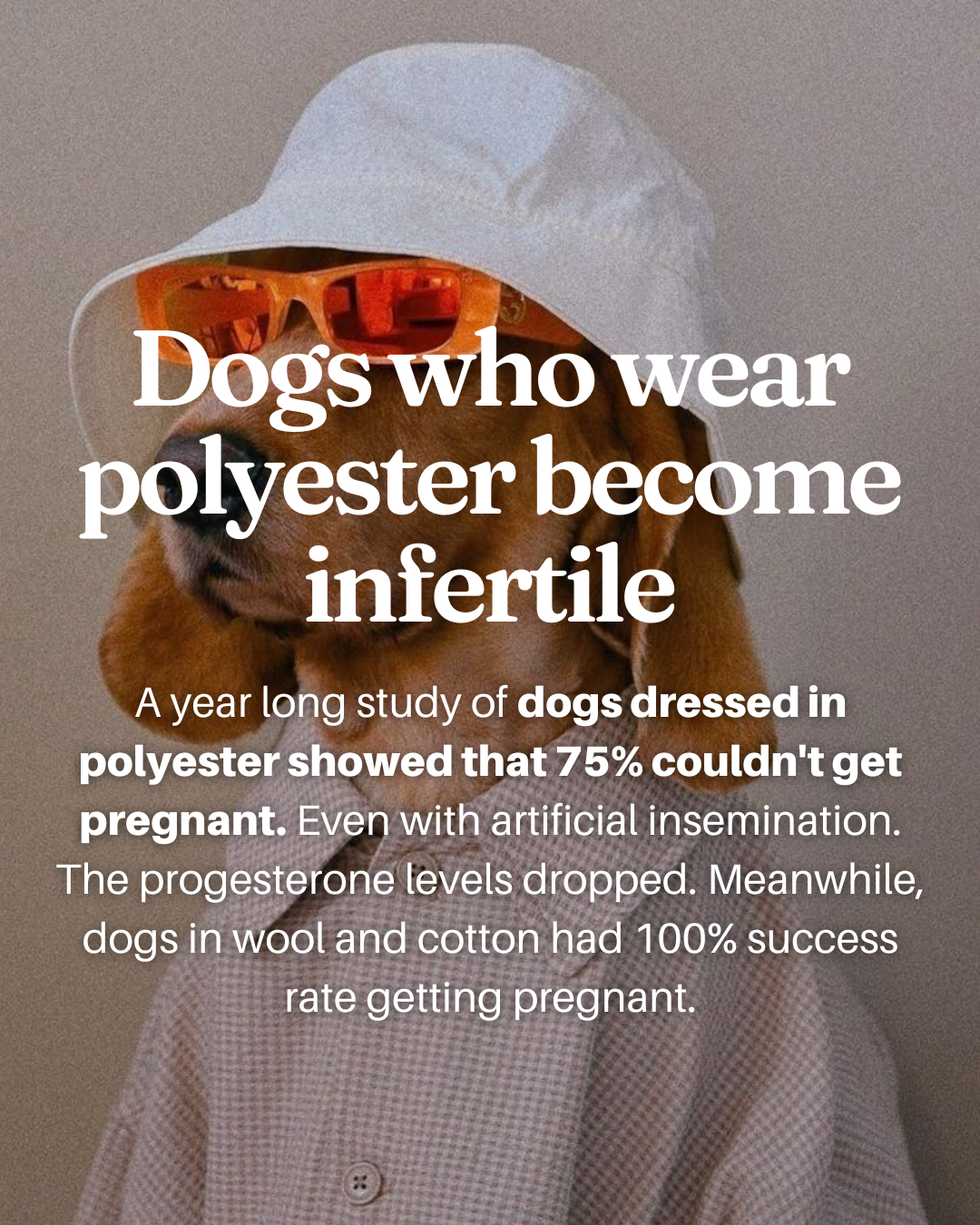
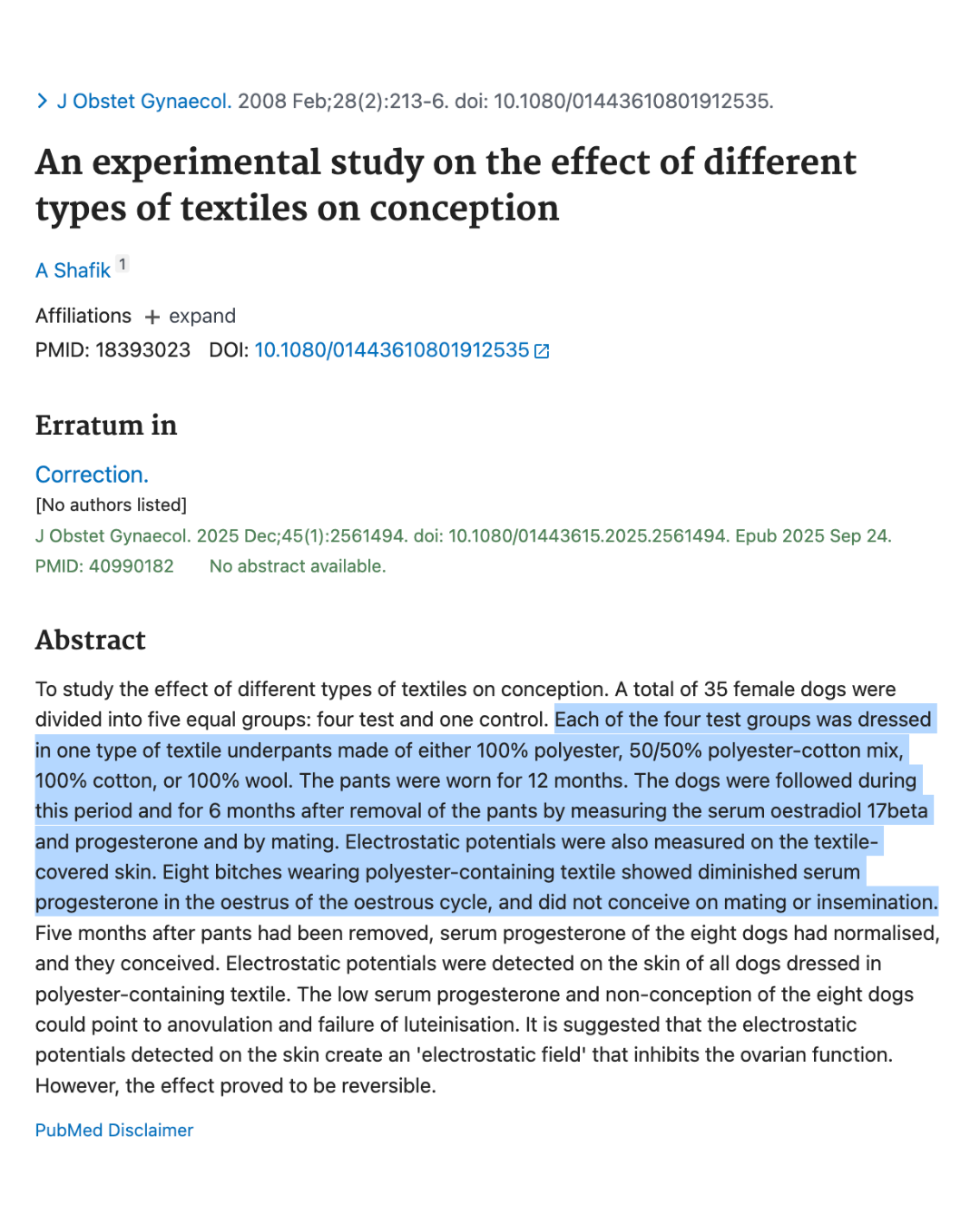
Two things keep this grounded. Both fertility studies came out of the same lab, which makes the work intriguing but not yet confirmed by independent groups. And the 2008 paper has since picked up a published correction. File it under “remarkable if it holds up,” not “settled law.” It is still a perfectly good reason to put your dog in cotton.
Same pattern in men and dogs: plastic on, fertility down. Plastic off, fertility back.
It runs on heat and static, and it does not stop at fertility
The mechanism is almost disappointingly physical. Polyester traps heat, and reproductive tissue is famously fussy about temperature. It also builds a static electric charge against skin, far more than natural fibers do, which the studies actually measured. Heat plus a low-grade electrostatic field is apparently enough to nudge a finely tuned hormonal system off its rhythm.
That same plastic-against-skin relationship is why fertility is only the attention-grabbing headline, not the whole concern. Polyester, nylon, and acrylic are petroleum products, and every wash sheds them. A synthetic load can release hundreds of thousands of microplastic fibers down the drain in a single cycle, and a meaningful share of what sheds never reaches the drain at all.
Those fibers end up in oceans, in soil, in drinking water, and increasingly in us, turning up in blood, lungs, and placentas. We are still early in understanding what that means, and “still early in understanding” is rarely the phrase you want attached to something taking up permanent residence in your bloodstream.
The reasonable response is not panic. It is the oldest move in wellness: when something is cheap, synthetic, and newly everywhere, and the long-term data is not in yet, lean toward the materials humans wore for ten thousand years without incident.
Polyester traps warmth against skin, and reproductive tissue is unusually sensitive to temperature.
Plastic fibers build a measurable electrostatic charge that natural fibers simply do not.
Microplastic fibers a single synthetic wash can release, ending up in water, soil, and bodies.
The cheaper the brand, the more plastic you’re buying
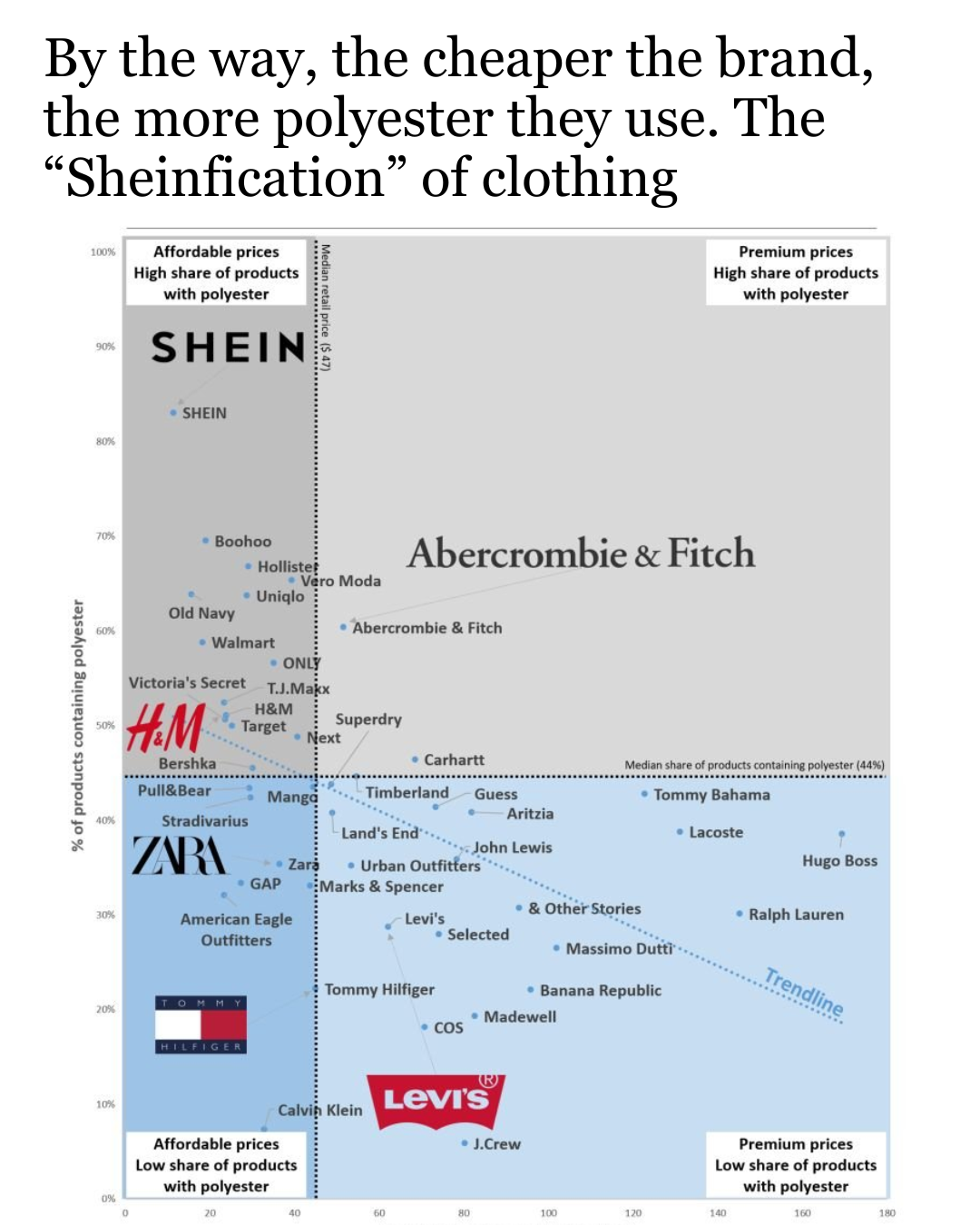
There is a tidy correlation hiding in your closet: the lower the price, the higher the polyester. It is not a coincidence. Polyester is cheaper than cotton, far cheaper than wool, dries fast, resists wrinkles, and lets a garment be made and sold for the price of a sandwich. The entire fast-fashion model runs on it.
There is even an unofficial name for the race to the bottom, the “Sheinification” of clothing, after the brand that perfected selling petroleum as a seven-dollar top. The pattern holds across the whole market: budget labels lean heavily synthetic, and the share of plastic falls as you climb toward brands that still bother with natural fibers.
This is the quietly empowering part. You do not need a lab, a supplement, or a subscription to opt out. You need to flip the tag. The information is printed on every garment ever sold, for free, in tiny letters most people have never once read.
“Vegan” clothing is mostly just plastic with a halo
Few marketing moves are as quietly absurd as labeling a polyester garment “vegan” and charging extra for the virtue. Vegan leather is plastic. Vegan wool is plastic. The animal-free fabric is, with reliable frequency, polyester, acrylic, or nylon, fossil fuel shedding microplastics with every wash and biodegrading sometime after the heat death of your great-grandchildren.
Wool, meanwhile, is the fiber that keeps showing up well in every column that matters. It is naturally flame-resistant, antibacterial, moisture-wicking, temperature-regulating, and fully biodegradable. The sheep grows a fresh coat every year whether anyone buys it or not, and wool farmers frequently sell it at a loss, which tells you how upside-down the incentives have gotten.
Selling petroleum and calling it ethical is a neat trick. The honest hierarchy is unglamorous and very old: wool, cotton, linen, silk. Grown, not refined. Compostable, not permanent. Kinder to your skin and your hormones precisely because they are not plastic.
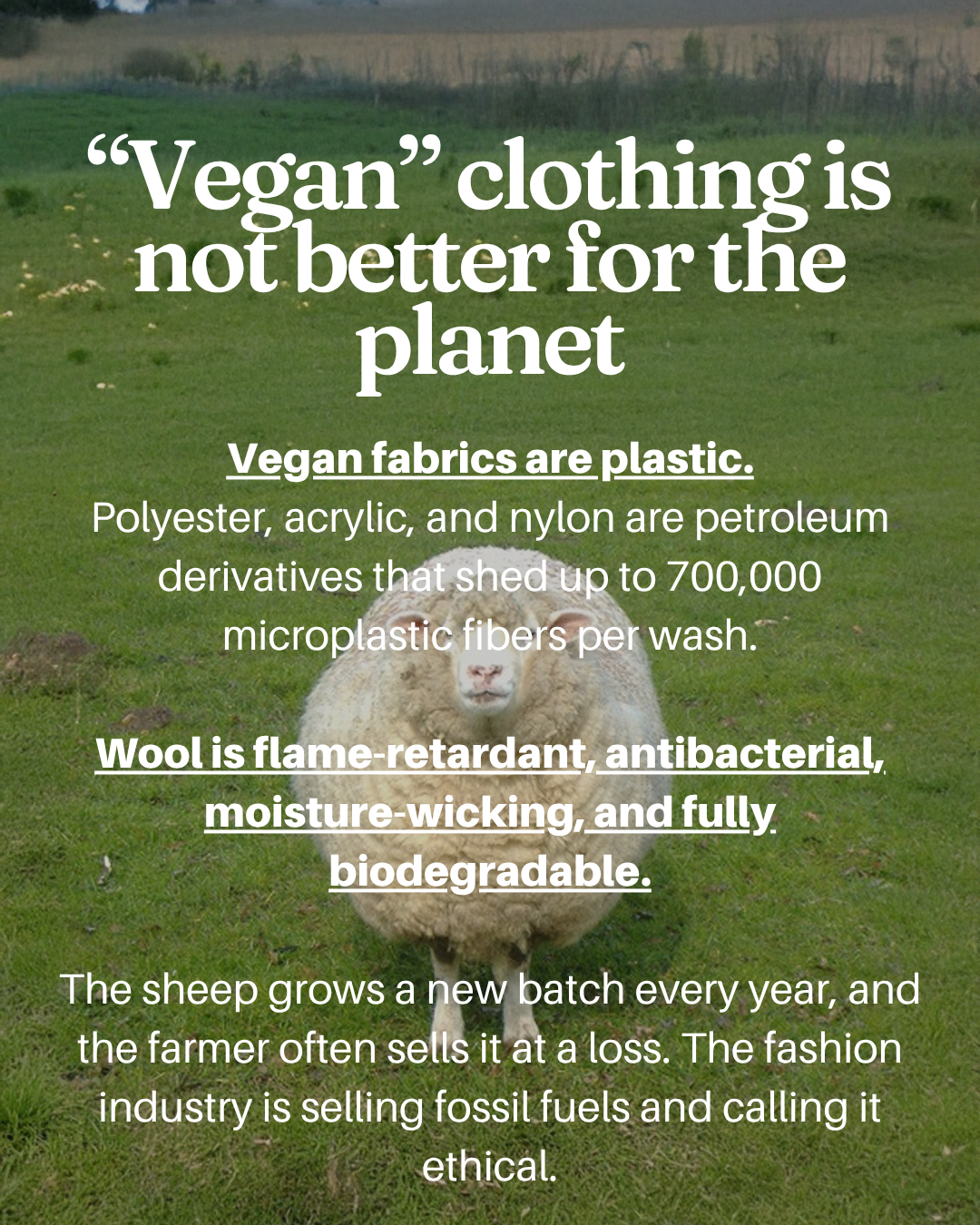
Grown, not refined. Compostable, not permanent. The honest hierarchy is very old: wool, cotton, linen, silk.
Getting the plastic off your skin without buying a new wardrobe
None of this requires a closet purge or a guilt spiral. Switch in the order that touches you most, replace things as they wear out, and let the upgrade happen naturally over a season or two. The point is direction, not perfection.
-
1
Read the tag, every time
Make flipping the label a reflex, the way you would check an ingredient list. You are looking for cotton, wool, linen, silk, and hemp, and politely declining polyester, acrylic, nylon, and anything sold as a “performance” blend.
-
2
Start with what touches the most sensitive parts
Underwear and base layers first. It is the highest-contact, highest-heat, most worthwhile swap, and conveniently the one the studies care about. Organic cotton or merino wool both do the job.
-
3
Fix the eight hours you spend in bed
Bedding is a third of your life pressed against fabric. Cotton, linen, or wool sheets beat polyester microfiber on comfort, temperature, and microplastic load, every single night.
-
4
Rethink the workout gear
Synthetic activewear is peak heat plus sweat plus static. Merino and cotton options exist, perform well, and do not turn your dresser into a microplastic dispenser.
-
5
Wash less, wash cool, line dry
Every wash sheds fibers and wears clothes down. Cooler water, fuller loads, gentler cycles, and air drying make natural fibers last for years, and keep any remaining synthetics from shedding as fast in the meantime.
-
6
Buy less, buy better, keep it longer
A few well-made natural-fiber pieces outlast a drawer of disposable plastic and cost less over time. That is the whole non-toxic-and-beautiful thesis, sitting quietly in a laundry basket.